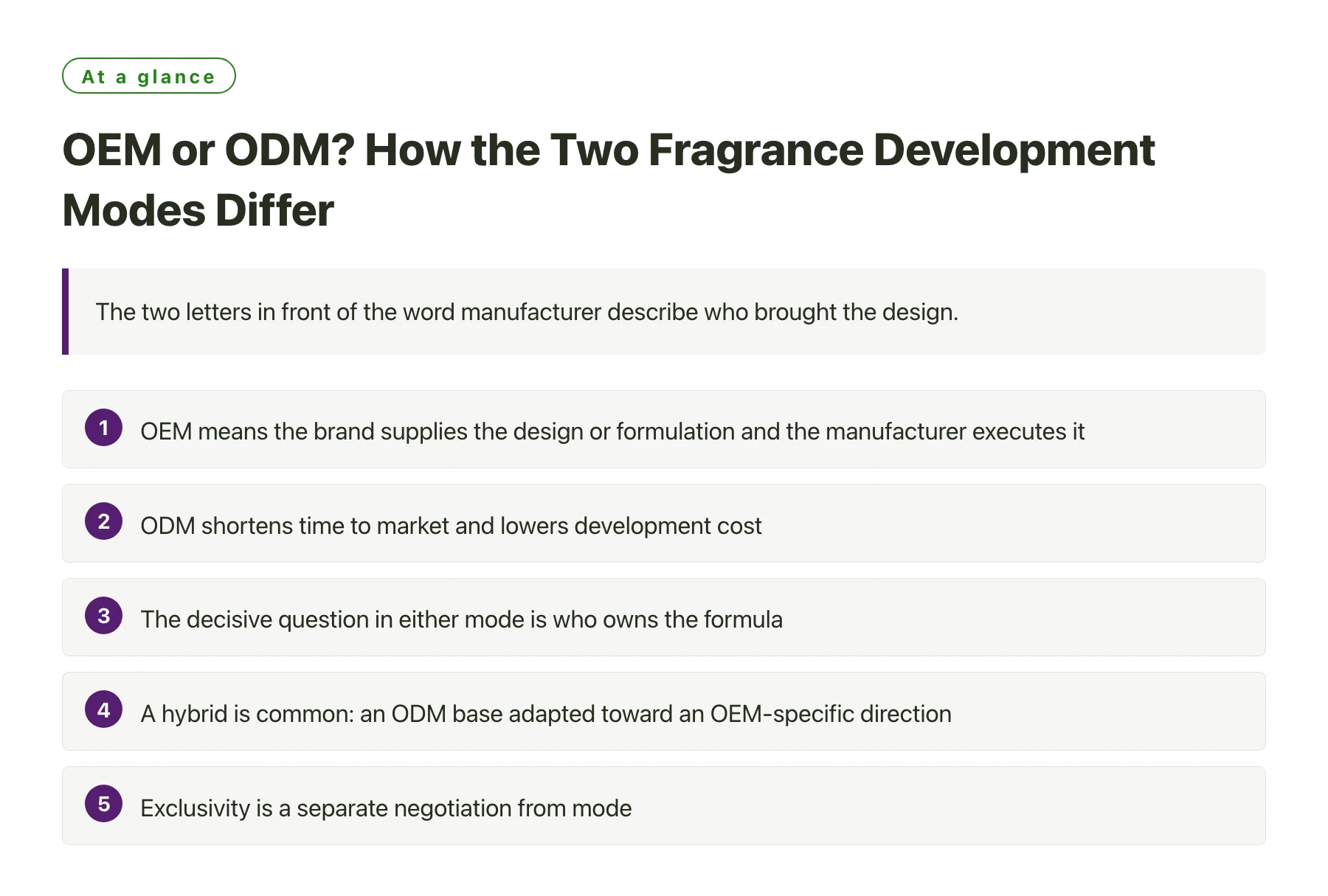
The two letters in front of the word manufacturer describe who brought the design. In an OEM arrangement the brand brings the formula or the concept and the factory builds it; in an ODM arrangement the manufacturer brings a developed concept that the brand adopts. Neither is more advanced than the other, and the wrong choice is usually made for cost reasons when the real difference is control.
Key takeaways
- OEM means the brand supplies the design or formulation and the manufacturer executes it; ODM means the manufacturer supplies a developed concept.
- ODM shortens time to market and lowers development cost, while OEM gives the brand tighter control over a distinctive formula.
- The decisive question in either mode is who owns the formula, the moulds and the artwork after the relationship ends.
- A hybrid is common: an ODM base adapted toward an OEM-specific direction, with the modification scope written into the agreement.
- Exclusivity is a separate negotiation from mode, and it should be agreed in writing for any concept you intend to build a brand on.
Ask five suppliers to explain the difference between OEM and ODM and you will get five answers. That is because the letters are used loosely in the industry, sometimes as a description of who develops the fragrance and sometimes as a description of who owns the mould.
The distinction matters commercially rather than linguistically. It decides whether you pay for development, whether your competitor can buy the same scent, and whether you can move production later without starting over.
This article separates the two modes along the dimensions that affect money and risk: who develops, who owns, who is exclusive, and how much of the work can be moved.
The two modes side by side
| Dimension | OEM | ODM | Why it decides cost |
|---|---|---|---|
| Who brings the concept | The brand, sometimes with a perfumer of its own | The manufacturer, often from an existing library | Development hours are either billed to you or already amortised |
| Who owns the formula | Normally the brand, subject to the contract | Normally the manufacturer, unless exclusivity is bought | Ownership is what you pay for when you move to another supplier |
| Time to first sample | Longer, because the direction has to be built | Shorter, because a base already exists | Launch timing is the hidden cost of a longer development cycle |
| Typical minimum order | Higher, because the formula is dedicated | Lower, because the base is shared | Shared bases spread setup cost across several clients |
| Reformulation risk | Largely under the brand's control | Dependent on the manufacturer's library decisions | A restricted material change can force a revision you did not plan |
Read the table as a map of trade-offs rather than a ranking. The row that surprises brands most often is the second one: a low-cost ODM project can become expensive later if the formula cannot travel with you.
What each mode is genuinely good at
The modes developed because different companies need different things from a factory. A brand with a clear scent idea and a long product life needs execution more than invention. A retailer that wants a coherent house range quickly needs a starting point more than a blank page.
Both needs are legitimate. Problems appear when a brand buys one mode but assumes the characteristics of the other, such as expecting exclusivity from a shared library formula or expecting a fast turnaround on a concept nobody has built before.
When OEM is worth the extra cost
OEM suits a brand whose fragrance is part of the product's identity and whose volumes justify dedicated development. The brand pays for the development work, but it also controls the direction, the modifications and the record of what is inside the bottle.
It also makes a later move easier. When the formula belongs to you in written terms, changing filling partner or scaling to a second site is a commercial decision rather than a redevelopment project.
When ODM is the better commercial answer
ODM suits line extensions, gift sets, seasonal editions and retail programmes where speed and unit cost dominate. Adopting a developed concept removes the sampling cycle and lets a range reach shelf in a single season.
The trade-off is differentiation. A concept available to you may also be available to a comparable brand in another market, which is why an exclusivity clause is worth negotiating even on an ODM base.
The hybrid most projects actually need
In practice many projects start from an existing base and then modify it: adjusting the opening, strengthening the base, or rebalancing the formula for a specific market. That is an OEM modification performed on an ODM foundation.
The scope of that modification is the part worth writing down. How many rounds, which materials may be changed, and whether the modified formula is then exclusive to the brand are all negotiable points that are much harder to raise once the launch is under way.
Choosing a mode without wasting a sampling round
- Decide what makes the product distinctiveIf the scent itself carries the brand promise, the formula needs to be yours. If packaging, price and placement carry it, a developed concept is sufficient.
- Put a number on time to shelfWrite the latest acceptable launch date and work backwards through sampling, stability checks and filling, then see which mode fits inside that window.
- Ask what happens to the formula when you leaveRequest the ownership position in writing before sampling. A short clause that names formula, moulds and artwork removes most of the future argument.
- Price exclusivity separatelyAsk what an exclusive version of a library formula would cost, in development and in minimum order quantity, so you can compare it fairly against dedicated development.
- Confirm who handles design rightsBottle shapes, closures and decorative elements can carry registered design protection in several jurisdictions, and the registration picture changes what you may copy or adapt [1].
- Write the modification scope into the briefName the direction, the number of rounds and the materials that may or may not be changed, so both sides know when development is finished.
The parts of the decision that are not about the mode
Two projects with the same mode label can perform very differently depending on how the brief is handled. A well-briefed ODM project with clear direction usually beats a vague OEM project, because the development function has something to aim at.
It also helps to know how the wider industry organises development. Membership bodies and industry foundations track how fragrance houses structure creative and technical work, and that context makes supplier claims easier to place [2].
Brief quality outranks mode
A brief that names the market, the wear profile, the price ceiling and two or three references gives any capable supplier enough to work with. Without it, a dedicated development budget is spent guessing.
That is one reason to settle the internal brief before choosing OEM or ODM, since the brief determines how much development work is really needed.
Category conventions vary more than the labels suggest
Fine fragrance, home fragrance and scented body products each have their own conventions about who develops and who owns. A supplier strong in one category may follow a different model in another, so confirm the mode within the category you are buying.
The industry press follows these shifts across categories and markets, which is a useful way to sanity-check whether a proposed arrangement matches current practice [3].
Decide before you sample
Sampling before the mode is settled wastes rounds, because the two modes produce different kinds of feedback. An OEM sample is judged against your own direction; an ODM sample is judged as a proposal to accept, adapt or reject.
A manufacturer that operates both models, as Xuelei describes across its development and manufacturing services, will usually ask which one you want in the first conversation. Have an answer ready, and put the ownership consequence of that answer in writing before you agree a scope with a manufacturer that supports OEM and ODM.
The expensive mistake in this decision is choosing ODM purely because it is cheaper, then discovering two years later that the formula cannot move with the brand. If the scent is central to what you are selling, treat the ownership clause and the exclusivity position as part of the product cost, not as legal detail. If the scent is not central, choose the cheaper mode deliberately and spend the saving on packaging and marketing instead of pretending the formula is an asset.
Sources
- WIPO — World Intellectual Property Organization —— The UN agency for intellectual property; resources on industrial design and patent protection relevant to product and packaging design.
- The Fragrance Foundation —— A non-profit organisation for the fragrance industry, running perfumery education programmes and industry recognition.
- Cosmetics Business —— A trade publication covering the beauty and cosmetics industry, including fragrance launches and regulatory developments.
Frequently asked questions
Is OEM better than ODM for a new fragrance brand?
It depends on whether the scent itself is the brand's differentiator. A brand built around a signature scent usually benefits from owning the formula. A brand built around price, packaging or placement often gets to shelf faster and cheaper with an adapted existing concept.
Can I switch from ODM to OEM later?
Sometimes, but only if the ownership position allows it. If the formula belongs to the manufacturer, moving means redeveloping the scent, which may not reproduce exactly. Negotiate the transfer terms before the first order rather than after a successful launch.
What does exclusivity cost in an ODM arrangement?
It is normally priced as a development fee, a higher minimum order quantity, or both, because the manufacturer gives up selling the same concept to others. Ask for the exclusive and non-exclusive prices together so the premium is visible.
Who owns the bottle mould in each model?
That is usually negotiated separately from the fragrance. A custom mould paid for by the brand is normally the brand's asset, while a stock mould remains the manufacturer's. Confirm in writing where the mould is held and what happens to it if the relationship ends.
Does ODM mean the same as private label?
The terms overlap but are not identical. Private label usually describes a finished product sold under the retailer's own name, which can be produced under either mode. ODM describes who developed the concept, so a private label product may be OEM or ODM depending on its origin.