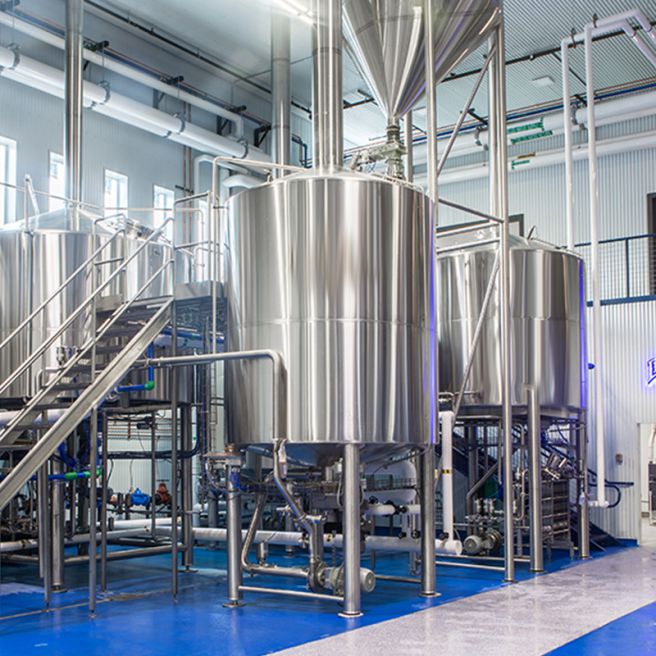
A craft brewery should choose its brewhouse by daily turns, fermenter size, recipe mix, labor hours, utilities, and annual output—not vessel count alone. A 10 bbl 2-vessel system may suit a taproom brewery brewing 1–2 turns per day, while a 20 bbl 3- or 4-vessel system is better suited to repeated production where separate lautering, boiling, and whirlpool stages reduce waiting time. Brewers Association benchmarking for 2017–2021 found that breweries producing 1,000–10,000 bbl annually used a median 7.5 bbl of water and 62 kWh of electricity per packaged barrel. Equipment selection therefore affects far more than batch volume.
A 2-vessel brewhouse normally combines mash and lautering in one vessel and boiling and whirlpooling in another. The layout reduces the number of tanks, valves, pumps, platforms, and transfer lines, so it works well where floor space and production frequency are limited. A 10 bbl brewery making two turns can nominally prepare 20 bbl of wort in a brew day, while four turns would require the same shared vessels to be emptied, cleaned, refilled, and reused repeatedly. At 50 brewing weeks per year and three brew days per week, two 10 bbl turns provide a theoretical 3,000 bbl of hot-side production before losses.
That calculation explains why vessel separation becomes more useful as weekly volume rises. A third vessel can separate the kettle from the whirlpool or separate mashing from lautering, depending on the manufacturer and process design. Once one batch leaves the kettle for a dedicated whirlpool, the kettle can begin receiving the next wort sooner. A brewery producing three 20 bbl turns on each of three weekly brew days has nominal hot-side capacity of 9,000 bbl across 50 weeks, nearly three times the previous example without tripling the batch size.
A brewhouse should be measured by how many finished turns fit inside the planned working day, not only by the volume stamped on the vessel nameplate.
A 4-vessel layout normally provides dedicated mash, lauter, kettle, and whirlpool vessels. More operations can overlap, which matters when a brewery repeatedly runs three, four, or more batches in one production period. The extra vessel does not automatically increase annual beer sales; fermentation space, yeast schedules, packaging capacity, labor, and market demand still limit output. For a brewery filling 40 bbl fermenters from a 20 bbl brewhouse, two brews are required for each tank. Filling six fermenters therefore requires 12 turns, whether completed across 2 days, 4 days, or a longer production schedule.
| Production situation | 2-vessel | 3-vessel | 4-vessel |
|---|---|---|---|
| 1–2 turns per brew day | Common fit | Extra scheduling room | Often underused |
| 2–3 turns per brew day | Possible with sufficient time | Strong practical fit | More process overlap |
| 3–5 turns per brew day | Shared vessels can slow scheduling | Suitable in many layouts | Usually easier to schedule |
| Small existing building | Lowest vessel footprint | Moderate | Highest |
| Frequent recipe changes | More shared-vessel cleaning | Better separation | Most process separation |
| High production frequency | Longer scheduling pressure | Moderate-to-high capacity | Designed for repeated turns |
Actual cycle time depends heavily on the recipe. A low-gravity pale ale and a strong stout can occupy the same brewhouse for very different periods. Large grain bills increase mash volume and grain-bed depth, while wheat, oats, rye, and other materials can slow runoff. If a normal lauter takes 75 minutes but a high-gravity recipe takes 120 minutes, the 45-minute difference repeated across four turns adds 3 hours to the production day. A larger lauter tun, effective raking system, suitable wort collection geometry, and well-managed grain milling may matter more than adding another vessel when lautering is the slowest stage.
The same reasoning applies to kettle sizing. A nominal 20 bbl batch cannot simply be matched with a vessel that holds exactly 20 bbl because wort expands during heating and vigorous boiling requires headspace. Working volume, gross volume, boil-off rate, heating surface, and foam behavior all need to be specified. A brewery targeting an 8% hourly evaporation rate from 22 bbl of pre-boil wort loses roughly 1.76 bbl to evaporation in one hour before accounting for trub and transfer losses. A recipe requiring 90 minutes of boiling raises the thermal requirement and keeps the kettle occupied longer.
Heating capacity therefore affects vessel utilization. Steam jackets are common in commercial systems because they distribute heat across jacketed surfaces and can serve several vessels from one boiler, while electric systems can suit smaller facilities where steam infrastructure is difficult to install. Direct-fire designs are also used, although burner sizing, exhaust, heat distribution, and local installation requirements must be considered. In the Brewers Association's 2017–2021 dataset, 48 breweries producing 1,000–10,000 bbl per year reported a median natural-gas use of 2.7 therms per packaged barrel.
Energy is only one utility constraint. Water enters mashing, sparging, cleaning, rinsing, cooling, and general sanitation, so brewhouse configuration affects both consumption and wastewater volume. The Brewers Association's 2017–2021 benchmarking sample included 49 breweries in the 1,000–10,000 bbl range; median water consumption was 7.5 bbl of water per bbl packaged. The top 25% used between 3.5 and 4.6 bbl/bbl, while the lower-performing quartile started at 14.0 bbl/bbl. The spread shows why tank design, cleaning practice, heat recovery, and water reuse deserve attention during equipment specification.
A heat exchanger illustrates the connection between brewing and utility planning. Cooling 20 bbl of near-boiling wort requires enough cold-side capacity to reach fermentation temperature at the required transfer rate. Breweries commonly recover warm outlet water from wort cooling into a hot liquor tank rather than send it directly to drain. If the HLT is too small, that recovered water has nowhere useful to go; if the CLT or glycol system is undersized, knockout can take longer and delay the next vessel transfer. A brewhouse quote should therefore be reviewed together with HLT, CLT, heat exchanger, boiler, refrigeration, and water-storage specifications.
Equipment efficiency also affects the cellar. Assume a brewery has four 40 bbl fermenters and a 20 bbl brewhouse. Two turns fill one fermenter, so filling all four requires eight turns. At an average 4.5 hours from mash-in to knockout for the first batch, followed by overlapping turns, vessel arrangement can change whether eight turns fit into two normal shifts or require extended production hours. Adding a larger brewhouse would reduce the turns required, but it may also require larger fermenters, pumps, piping, heat exchangers, and utility service.
Buying more hot-side capacity while leaving the cellar unchanged can move waiting time from the brewhouse to the fermenters rather than increasing packaged output.
Cellar residence time deserves equal attention. A brewery making ales with 14–21 days of combined fermentation and conditioning can reuse tanks considerably faster than one holding lagers for 4–6 weeks. Ten 40 bbl fermenters turning every 20 days provide a different annual production ceiling from ten identical vessels occupied for 35 days. A brewhouse that can produce 80 bbl every day gains little when no empty tank is available to receive wort. Vessel count should be modeled together with tank occupancy across at least a 12-month production calendar.
Automation changes the labor side of the calculation. Temperature control, automatic water dosing, valve positioning, pump speed, step-mash programs, vessel level monitoring, and recipe storage can reduce repeated manual tasks. Automation does not remove the need for operators because grain handling, ingredient additions, sampling, cleaning, verification, maintenance, and abnormal conditions still require people. The Brewers Association's brewery safety program includes separate training modules for mashing, boiling, whirlpooling, cooling, fermentation, cleaning, packaging, and chemical handling, reflecting the number of operations that remain part of normal brewery work.
Cleaning time should be included in capacity calculations for the same reason. A vessel available at 2:00 p.m. is not ready for the next product at 2:01 p.m. if rinsing, chemical circulation, verification, or manual removal of residue is required. Brewers Association safety material treats clean-in-place work as a specific brewery operation because it combines hot liquids, pumps, chemical exposure, and pressure-related procedures. A design with fixed spray devices, suitable CIP flow, accessible sample points, well-positioned drains, and uncomplicated piping can save repeated labor over hundreds of cleaning cycles per year.
Floor layout can then be evaluated with actual operating movement rather than tank dimensions alone. A four-vessel brewhouse may occupy more production area, but vessel shells are only part of the space requirement. Grain-out access, stairs, working platforms, hoses, pumps, control panels, maintenance clearance, chemical storage, spent-grain removal, and forklift or pallet movement also need room. A brewery that saves 20% of equipment footprint but creates difficult access around valves and manways may spend that space saving in additional operator time during every brew and cleaning cycle.
Batch size should also match the sales mix. A 30 bbl brewhouse is efficient when the brewery regularly needs 30, 60, or 90 bbl of the same beer, but less convenient when weekly demand for several products is only 5–10 bbl each. A smaller system allows more individual recipes, although it requires more turns to produce high-volume brands. Breweries with a taproom portfolio of 12–20 rotating beers usually face a different production pattern from breweries packaging a smaller number of brands for wholesale distribution.
For breweries comparing craft beer equipment, nominal tank volume should therefore be checked against working capacity, grain capacity, heating rate, lauter area, pump flow, heat-exchanger performance, automation scope, and utility demand. In the Brewers Association's 2017–2021 benchmarking group for 1,000–10,000 bbl breweries, 55 participants reported a median 62 kWh of electricity per packaged barrel, while the top 25% boundary was 50 kWh/bbl. Equipment and operating practice both contribute to that difference, so utility assumptions belong in the purchasing comparison rather than being added after installation.
Capital cost should be compared with labor use rather than viewed alone. Suppose a simpler system needs 2 additional operator-hours for each multi-turn brew day. At 120 brew days per year, that is 240 labor-hours annually before payroll taxes, overtime, training, or management time. A more separated vessel layout may reduce waiting, but the financial case depends on how often the brewery uses the saved time. A brewery running one batch twice a week will recover little from equipment designed around four daily turns; a brewery running 200 or more multi-turn production days has a different calculation.
Water and energy benchmarks also improve purchasing discussions because they give owners measurable questions for vendors. The 2014–2018 Brewers Association sample for breweries producing 1,000–10,000 bbl annually included 89 water-use reporters and 93 electricity-use reporters. Median values were 8.7 bbl of water per packaged bbl and 65 kWh/bbl of electricity; the later 2017–2021 report showed medians of 7.5 bbl/bbl and 62 kWh/bbl. The datasets are self-reported rather than controlled laboratory measurements, so they work best as comparison ranges rather than guaranteed performance figures.
A brewery planning 5,000 bbl per year can turn the selection process into a production model. At 50 working weeks, average packaged output is 100 bbl per week. Allowing 10% total loss between wort production and packaged beer raises the approximate hot-side requirement to about 111 bbl per week. A 10 bbl system would need roughly 11 turns; a 20 bbl system about 6 turns; a 30 bbl system about 4 turns. Seasonal peaks, maintenance days, slow recipes, and fermentation schedules should then be added before vessel count is selected.
From there, the configuration becomes easier to match to the brewery. One or two turns per day can work comfortably with many 2-vessel systems when recipes and staffing allow enough time. Repeated two- or three-turn schedules give a 3-vessel layout more room to separate processes. Three to five daily turns make the scheduling advantages of four dedicated vessels more relevant, provided the cellar can accept the wort and the utilities can support the pace. The useful specification is the number of saleable barrels the complete brewery can produce within its real working schedule, not the maximum volume of one brewhouse vessel.