A factory visit in China can reveal useful evidence about processes, records, and production conditions, but only when the buyer knows what question the visit is meant to answer. Common failures include visiting the wrong site, relying on a tour, using undefined criteria, and leaving findings without an owner. Plan the scope and decision rules before travel or remote review.
Key takeaways
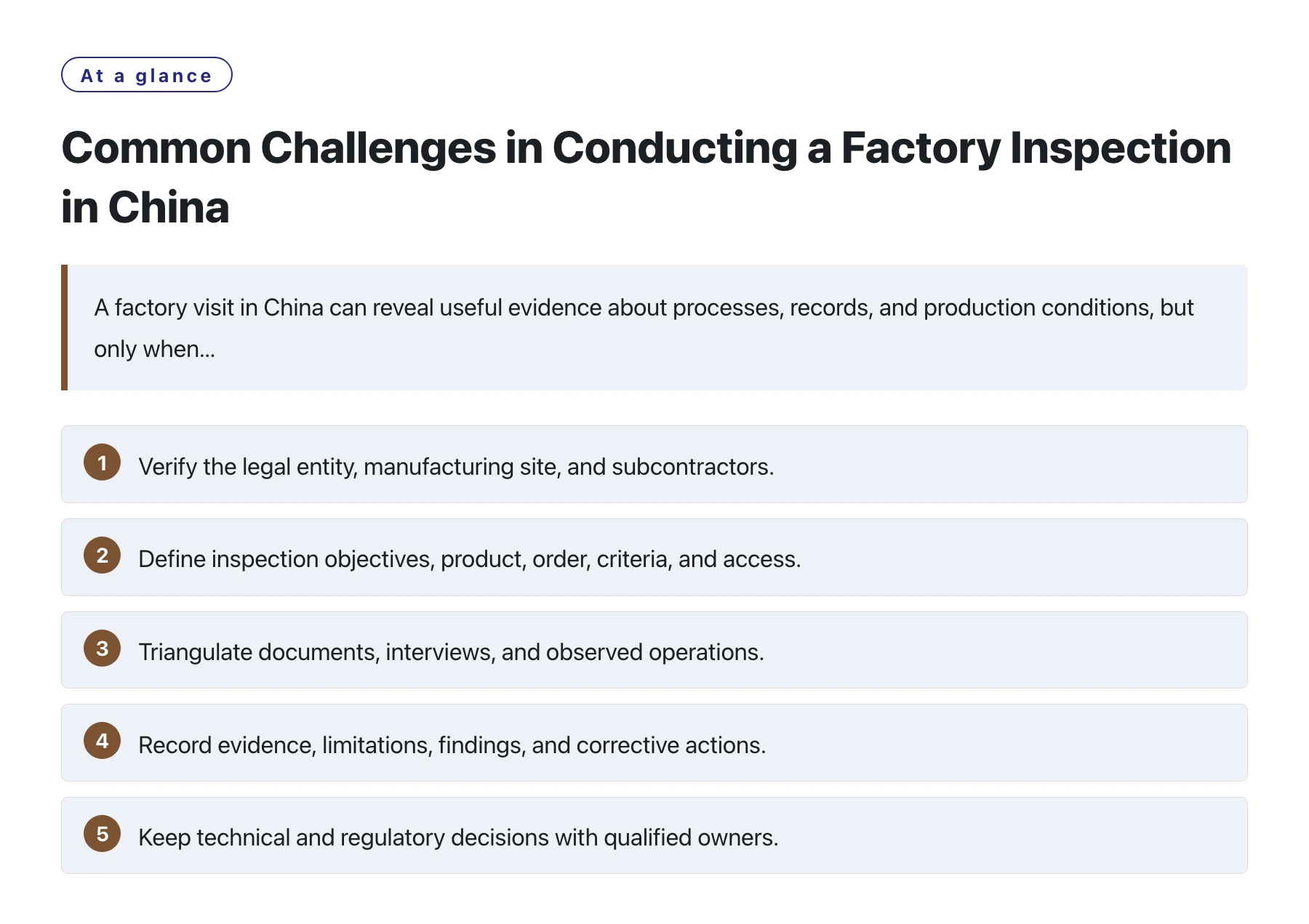
- Verify the legal entity, manufacturing site, and subcontractors.
- Define inspection objectives, product, order, criteria, and access.
- Triangulate documents, interviews, and observed operations.
- Record evidence, limitations, findings, and corrective actions.
- Keep technical and regulatory decisions with qualified owners.
A checklist turns requirements into repeatable observations and supports a decision within a clearly stated scope.
1. Verify the site before the visit
Confirm registered entity, actual production address, business relationship, and whether the factory is owned, leased, or subcontracted. Ask what processes occur at each site and which steps are external. Compare the visit address with quotation, certificates, invoice party, and product records.
A showroom or sales office may be different from the manufacturing location. Plan how the inspector will distinguish production areas, warehouse, office, and subcontractor operations. If identity or access cannot be confirmed, report that limitation rather than describing the site as fully assessed.
2. Define the inspection objective
Decide whether the visit assesses supplier capability, process readiness, order status, quality controls, social or environmental practices, or a specific product requirement. These objectives need different evidence and expertise. Identify order, product, revision, production stage, and intended decision.
Set the scope in writing with an agenda, criteria, records to review, people to interview, areas to observe, and any sampling. State exclusions. A broad request to “check the factory” does not give the inspector a reliable pass or fail basis.
3. Prepare a document and evidence list
Request site organization, process flow, equipment list, capacity assumptions, quality procedures, training records, calibration status, incoming inspection, nonconformance handling, and traceability samples relevant to the scope. Verify that records belong to the named site and current product.
ISO 9001:2026 specifies quality management system requirements; a certificate or system description can help frame process questions but does not establish that the site or a particular order automatically conforms. Review actual records and product evidence against buyer requirements. [1]
4. Observe real work, not only a prepared tour
Select an order or process route and follow material from receipt through key production and release steps. Observe whether workers use current instructions, identify materials, record inspections, segregate nonconforming goods, and maintain equipment as claimed. Ask operators to explain normal work rather than relying only on management presentations.
Take notes and permitted photos tied to process, time, and area. Protect confidential information and follow site safety rules. If production is idle or a process cannot be observed, record what alternative evidence was used and what remains unverified.
5. Check process controls and traceability
Choose a finished item or lot and trace it backward to component, material, work order, process records, and incoming inspection. Then trace a raw-material batch forward to products or orders. Compare identification on records with physical labels and warehouse controls.
Review the handling of deviations, rework, concessions, and customer complaints. Ask how changes are approved and how superseded drawings are withdrawn. A written procedure matters only if sampled records and observed practice show that the control is used.
6. Avoid judging product quality from a visit alone
A clean floor or modern machine cannot prove product conformity. Product checks require the buyer’s technical specification, samples, measurement methods, test conditions, and acceptance limits. Select separate product inspection or laboratory activities when the visit does not establish product-level evidence.
Do not let an inspector create missing engineering limits or regulatory conclusions. Refer unresolved matters to the named buyer, engineer, or compliance owner. Distinguish facility observations from order-specific release decisions in the report.
7. Report findings and limitations
The report should state date, site, participants, scope, records sampled, processes observed, evidence, photos, findings, exclusions, and conclusion. Separate facts from opinion and tie each gap to a defined requirement or risk. Mark documents not provided and areas not accessible.
Rank issues by impact and assign containment, corrective action, owner, due date, and verification. Ask the supplier to respond with evidence. Keep unresolved high-risk issues open until a qualified authority accepts the disposition.
8. Manage access, language, and conflicts
Agree confidentiality, personal protective equipment, photography, translation, and access expectations in advance. Use interpreters familiar with manufacturing terms where needed and confirm important statements in writing. Avoid relying on a single manager to interpret every operator interview.
Disclose the inspection provider’s role, payment, relationship, and limits. If a site refuses reasonable evidence or attempts to substitute another factory, document the issue and escalate it to the buyer before any commitment.
9. Turn the visit into a sourcing decision
Compare sites using the same criteria and evidence categories. State which capability was verified, which was not, and what conditions remain before placing or releasing an order. Revisit the assessment if the factory, process, or subcontractors change materially.
Buyers considering JS Sourcing can ask what visit scope, evidence, language support, and follow-up are included, while retaining authority over supplier acceptance and product-specific decisions.
Sources
Frequently asked questions
Does a factory tour prove a supplier can meet an order?
No. Verify the site and review order-specific process, capacity, product, and record evidence against defined requirements.
Should every inspection use the same checklist?
Use a common structure, then tailor criteria to the objective, product risk, production stage, and buyer decision.
Can an ISO 9001 certificate approve a specific product?
No. It concerns a quality management system; product conformity needs separate evidence against the order requirements.
What should happen after serious findings?
Record the evidence, contain affected risk, assign corrective action and owner, and verify closure before relying on the process.